Do you need a permit to remove that tree?
Updated 2026-10-18 · 10 min read · Removal & cost
Who actually writes the rule
Federal regulation governs how the work is done — the occupational safety rules that apply to the crew, sitting in Title 29 of the Code of Federal Regulations. Whether the tree may come down at all is a local question, and it is answered in a municipal code, a county ordinance, a subdivision plat condition or a private covenant. Four different documents, any of which can independently say no.
Sound
The four triggers
| Trigger | Typical form | How to check |
|---|---|---|
| Size | Any tree over a stated DBH (Portland: 12 in at 4.5 ft) | Measure it properly |
| Species | A protected or heritage list | Identify it before you call anyone |
| Location | Street trees, setbacks, riparian buffers, overlays | Your parcel's zoning page |
| Instrument | HOA covenant or a plat condition from subdivision | Your deed and HOA documents |
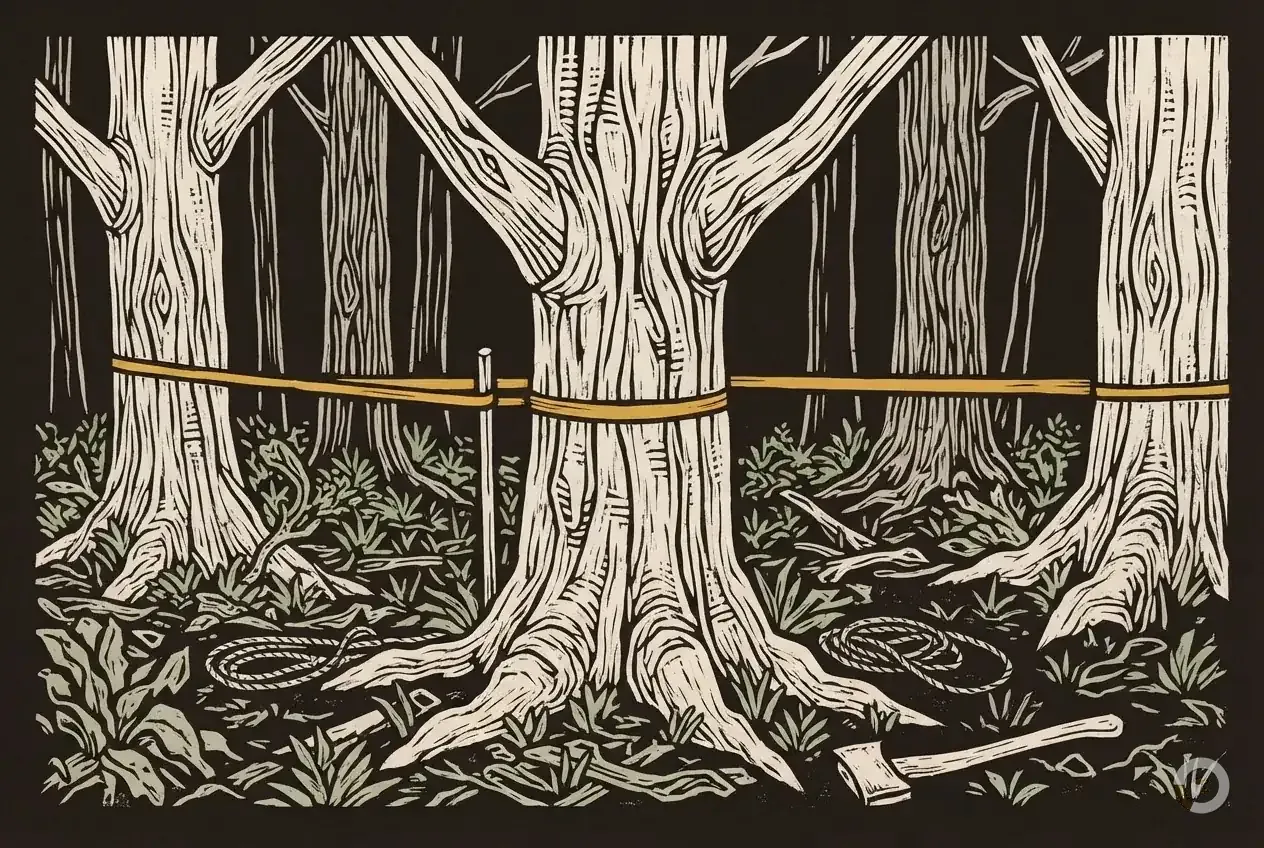
Size is the one people get wrong most often, because DBH is measured at 4.5 feet on the uphill side and multi-stem trees have their own rule. Measure it with the DBH calculator before assuming you are under the threshold.
Reading the ordinance: five terms that matter
Regulated / protected tree
The definition that decides whether any of the rest applies to you.
Heritage or specimen tree
A higher tier, usually by size or species, with a harder approval and bigger penalties.
Replacement ratio
How many trees you must plant, or what you pay in lieu. Often expressed in inches, not trees.
Critical root zone
A protected radius. Trenching or paving inside it can require a permit even with no removal.
Exemption
The list of situations the rule does not apply to — read this before assuming you need to apply.
Walk your own situation through the permit checker to see which of these you are likely to hit.
The hazard exemption, and how to use it properly
Nearly every ordinance exempts a genuinely hazardous tree, and nearly every ordinance requires the hazard to be documented — often by a qualified arborist, often before removal, and almost always with photographs. "It looked dangerous" after the fact is the weakest position available.
Stop
A dated risk assessment on a tree you are worried about is the document that makes this exemption usable rather than theoretical.
What it costs to get wrong
Penalties for unpermitted removal are commonly assessed per inch of DBH removed, sometimes with a replacement obligation on top, and they are routinely larger than the removal itself would have cost. Municipalities also use appraised value — the same trunk-formula approach as the appraisal calculator — which is how a single mature oak becomes a five-figure problem.
Applying costs a form and some waiting. Not applying costs the tree, the fine and the replacement. Once you know you are clear, price the job in the removal calculator.