Date Palm
Phoenix dactyliferaUSDA 9a+
Updated 2026-10-18 · Species & health
- Mature sizeAbout 50 × 25 ft
- Salt spray toleranceHigh
- Leaf typeFeather
- Hardy toZone 9a
- Trunk regrowsNever
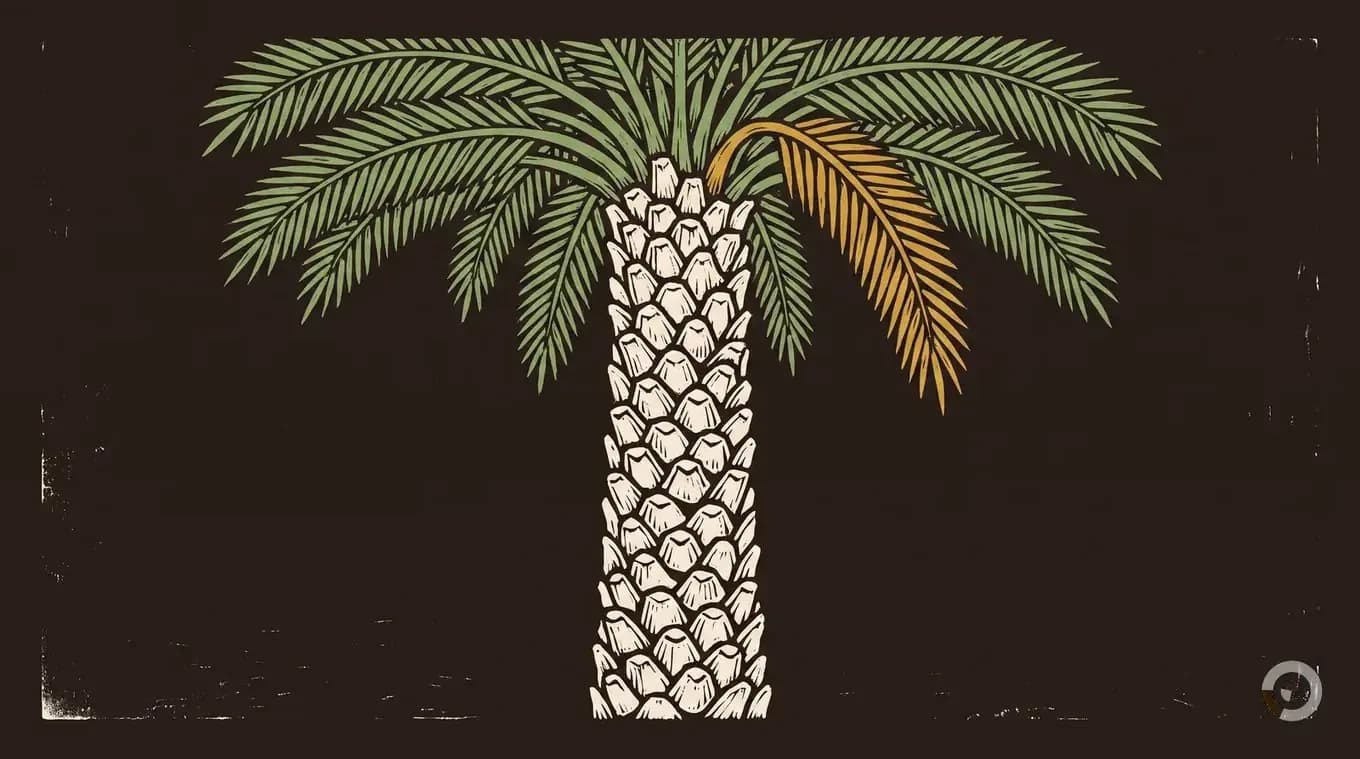
Four differences that change the work
| Feature | Broadleaf tree | Palm |
|---|---|---|
| Growing points | Thousands of buds | One, at the crown |
| Wound response | Compartmentalises and seals | Cannot; damage is permanent |
| Trunk | Adds girth every year | Fixed diameter for life |
| Pruning benefit | Structure, clearance, health | Almost entirely cosmetic and safety |
Drop zone
Over-pruning is the common harm
The "hurricane cut" — stripping the crown back to a handful of upright fronds — is sold as storm preparation and is the opposite. Green fronds are the palm's only food factory and its only nutrient reserve; removing them starves it, narrows the new trunk growth and leaves it more vulnerable, not less.
The defensible rule is to remove only fronds that are fully brown and dead, plus fruit stalks if they are a nuisance, and to leave anything still green. Anything else is being sold appearance at the plant's expense.
How palm work is priced
Palm pruning is a fast job with an access problem: a crew reaches the crown by lift or by rope and does perhaps fifteen minutes of actual cutting. That makes the access method almost the entire price, which is why the pruning-type factors in the trimming calculator matter less here and the reach setting matters more.
Removal is different again. A palm trunk is fibrous rather than woody and comes down in a small number of heavy sections — see the removal calculator, and treat its low DBH as a poor proxy for weight.
Timing, and the one real disease warning
University of Florida extension is plain about it: from the palm's point of view no time of year is better than another. The practical timing is to take dead leaves off before hurricane season, so they do not become missiles in a storm, which is why palms run across the whole year on the pruning calendar.
Watch
Sources
- UF/IFAS Extension EP020 — Palms for central Florida, Table 1: Phoenix dactylifera, feather leaf, typical size 50 × 25 ft, zone 9a, high salt spray toleranceretrieved 2026-10-18
- UF/IFAS Extension EP443 — Pruning palms: no time of year is better for the palm; prune dead leaves before hurricane season; disease spread on toolsretrieved 2026-10-18
- BLS OEWS May 2025 · 37-3013 · hourly mean $26.91 (palm pruning is the same occupation)retrieved 2026-09-04