What a tree removal actually costs
Updated 2026-10-18 · 11 min read · Removal & cost
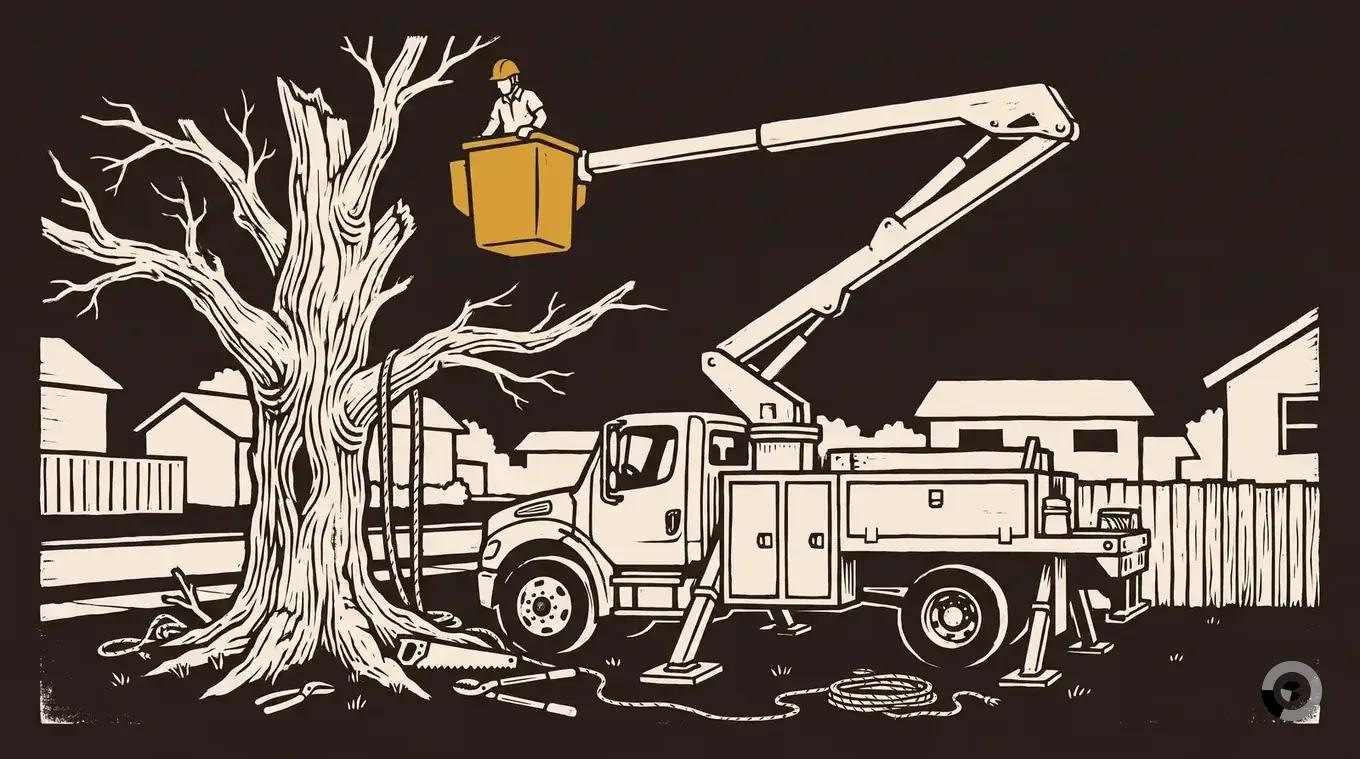
The model, not the average
Start with the people. The U.S. Bureau of Labor Statistics puts the hourly mean wage for tree trimmers and pruners at $26.91, the annual median at $50,960, across 55,160 people nationally (OEWS, May 2025). That is the climber's wage, not the cost of putting them under your tree.
Loading that wage for payroll tax, a high-risk workers' compensation class and non-billable drive time lands near $41.71 per crew-member hour. Three people on a standard removal makes roughly $125 an hour in labour before a single machine starts.
| Line | Per crew hour | Where it comes from |
|---|---|---|
| Loaded labour, 3 people | $125.13 | BLS mean × 1.55 × 3 |
| Chip truck + chipper | $45–$95 | Stated assumption, varies with the grinder or lift |
| Direct cost | $170–$220 | Sum of the two above |
| Bid multiplier | 1.6× – 2.1× | Overhead, insurance, margin |
Sound
What size actually does
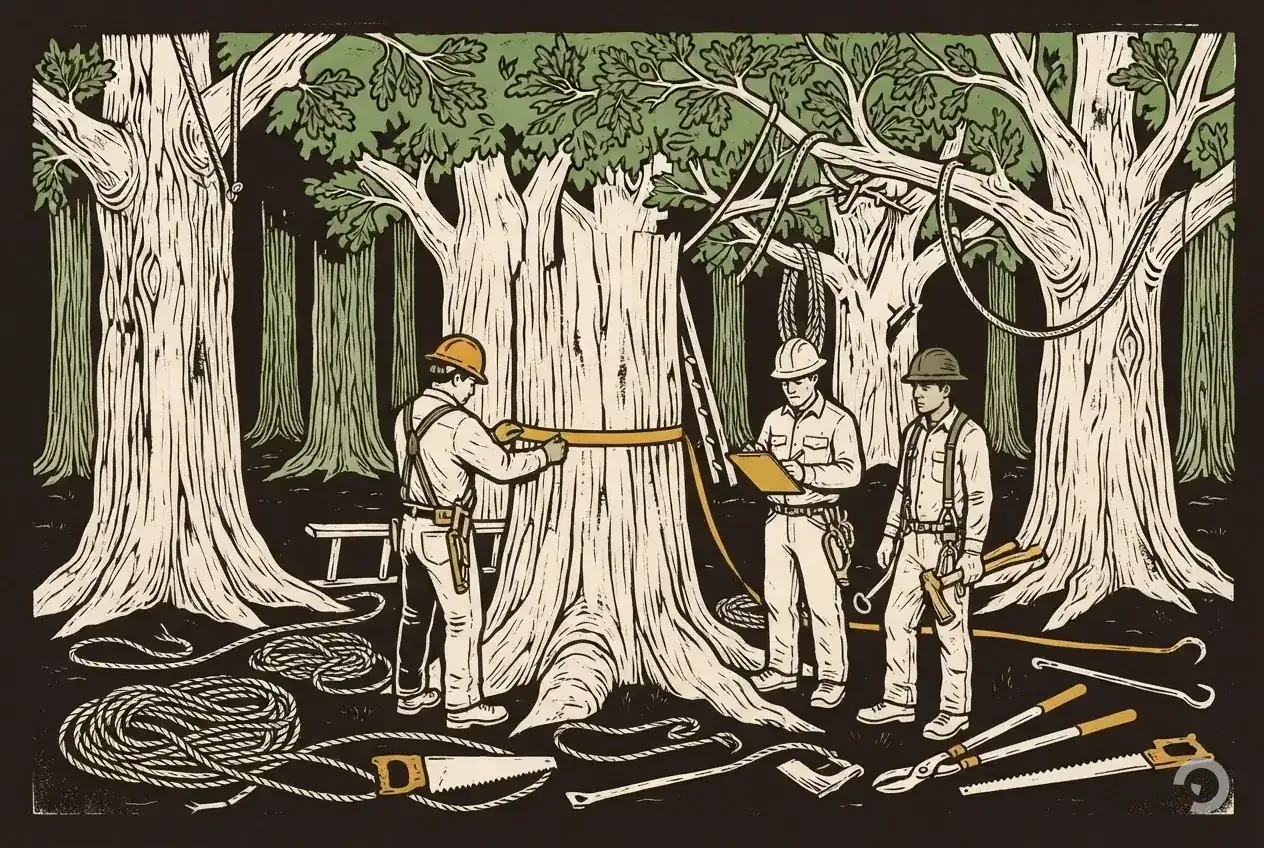
Price does not scale with height; it scales with the number of pieces the tree has to become. A tall, slim poplar in the open is fewer, lighter pieces than a squat, heavy-limbed oak of the same height. That is why the two numbers a crew writes down are diameter at breast height and height — together they approximate wood volume, and wood volume is time.
Doubling DBH does not double the price, because setup, travel and cleanup are close to fixed. It is roughly linear in the middle of the range and then jumps when the tree crosses into crane or lift territory — usually somewhere past 30 inches with a poor drop zone. Measure yours with the DBH calculator before you compare quotes.
Access is the multiplier
The single biggest driver is what sits underneath. An open drop is a felling job. A tree over a conservatory is a rigging job where every limb is roped, lowered, and cleared before the next cut — the same wood, two to three times the hours.
| Access | Hours multiplier | What it means on site |
|---|---|---|
| Open drop | 1.0× | Nothing under the tree; notch and fell |
| Partial | 1.45× | Fence, shed or driveway in the zone; some rigging |
| Tight | 2.1× | Roof, pool or wires; every piece roped and lowered |
Watch
The lines that get added
Four things routinely appear under the removal line, and all four are negotiable in a way the removal itself is not:
Stump grinding
Usually priced per inch of stump diameter, with a minimum. Cheapest bought on the same visit — the machine is already on the trailer.
Wood removal
Leaving rounds on site is free. Hauling them costs a trip. Ask for rounds if you burn.
Chip disposal
Chips are the crew's problem, not yours, unless you want them — in which case ask, they are usually glad to drop them.
Crane or lift day-rate
Charged by the day, not the tree. If a neighbour also needs work, split the mobilisation.
Whether to grind the stump or dig it out is its own decision, laid out in stump grinding vs stump removal. And if you are weighing the whole job against doing it yourself, the size and lean where that stops making sense are in DIY vs professional tree removal.
Reading a quote against the model
Three questions separate a fair quote from a guess. How many people, for how many hours? Is the stump included, and to what depth? Who carries workers' compensation for anyone in the tree? A company that answers all three in writing is pricing a job; one that will not is pricing you.
Run your own numbers first in the removal calculator, then check whether the tree needs removing at all — a risk assessment and a comparison against crown work have saved a lot of trees that were quoted for removal.
Sources
- OSHA 29 CFR 1910.333(c)(3) — unqualified persons keep 10 ft from energized overhead lines of 50 kV or lessretrieved 2026-10-18
- BLS OEWS May 2025 · 37-3013 Tree Trimmers and Pruners · hourly mean $26.91retrieved 2026-09-04
- BLS OEWS May 2025 · 37-3013 · annual median $50,960, 10th pct $37,940, 90th pct $80,310retrieved 2026-09-04
- BLS OEWS May 2025 · 37-3013 · national employment 55,160retrieved 2026-09-04