Prune it, or take it down?
Updated 2026-09-04 · Removal & cost
Trimming
Best overall
Most trees quoted for removal have a size or clearance problem, which pruning solves for a fraction of the cost.
Removal
Best for a structural defect
A decay column, a failed root plate or a split union over a target is not a pruning problem.
Cycle pruning
Best value
Light work every three to five years never becomes the reduction that costs as much as a removal.
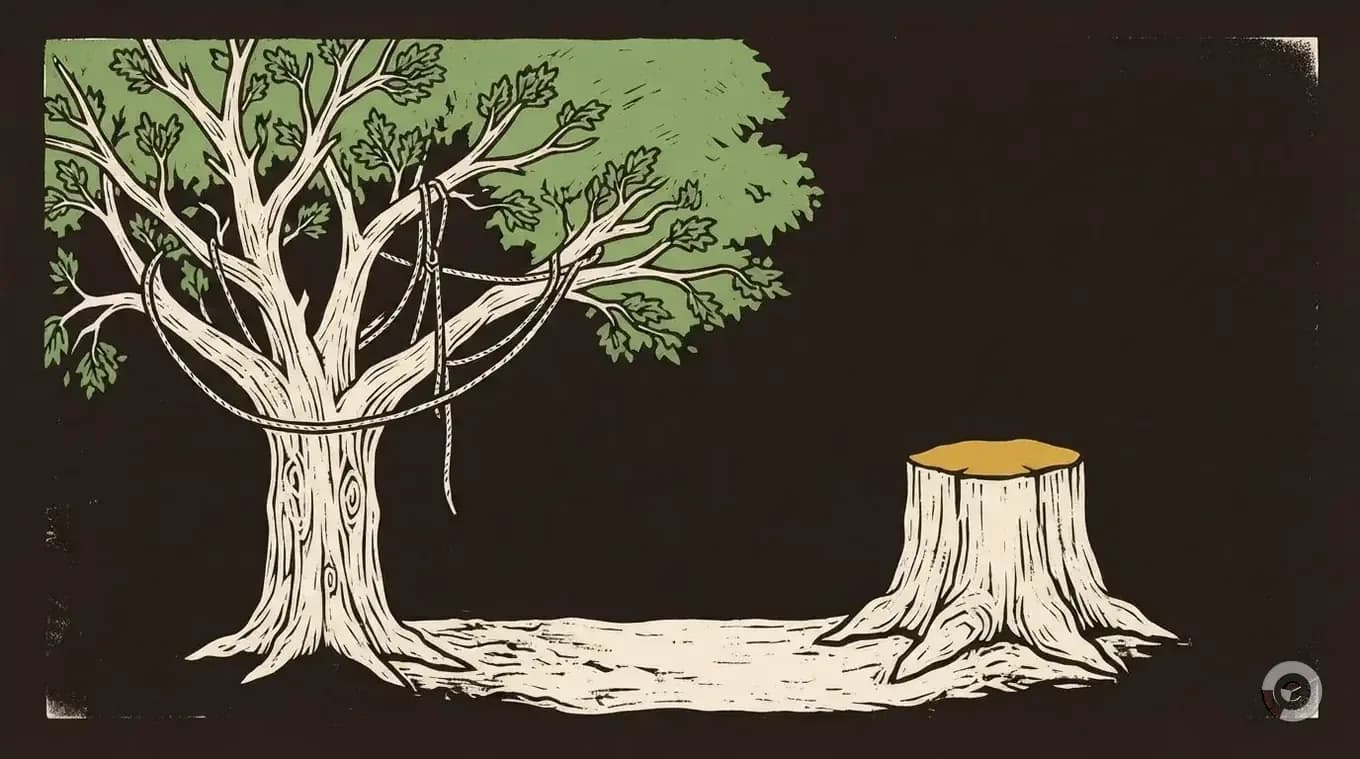
Our pick: Trimming
| Criterion | Trimming | Removal |
|---|---|---|
| Reversible | Yes — the tree keeps growing | No |
| Typical relative cost | 0.3× – 0.7× | 1× |
| Fixes clearance from a roof | Yes | Yes, permanently |
| Fixes a decay column in the stem | No | Yes |
| Fixes a weak codominant union | Partly — end-weight reduction | Yes |
| Keeps shade, screening, value | Yes | No |
| Permit likely | Rarely | Often |
The defect test
Ask what specifically is wrong. If the answer is a location — too close to the roof, blocking light, dropping over the drive — that is a crown work problem, and the trimming calculator will price it. If the answer is a condition — a hollow stem, a lifting root plate, half the canopy dead — pruning does not touch it.
Watch
The middle options people skip
Between the two sits real ground. End-weight reduction lowers the leverage on a weak union permanently. A cable limits how far two leaders can move apart. Moving the target — the parking space, the play equipment — lowers risk with no arboriculture at all.
Run the tree through the risk matrix first. A tier of Monitor means one of these middle options, not a removal.
What the price gap really is
Both jobs are the same crew, the same truck and the same loaded hourly cost derived from the BLS mean of $26.91 (OEWS, May 2025). Removal is more expensive because it is more hours and more wood, and because it often adds a stump.
Price both on the same tree in trimming and removal, then check whether removal even needs a permit — frequently it does.